Bathtub Reglazing

Bathtub Reglazing in Bath County, Virginia (VA)

All over Bath County, worn bathtubs are resurfaced in place: repairs first, gloss second, fresh caulk on the way out.

The technician covering your area draws up the figure. It comes in writing, before any van is booked.

Price my bathtub
  • Free, nothing owed after it
  • Routed to the technician for your area
  • A written figure before any spraying

One callback from the trade, not a switchboard reading a script, and silence after that if you prefer. Two minutes of plain description are enough to price a standard tub.

Same tubit never leaves the bathroom
One working daymasking in the morning, gloss by evening
24 to 48 hoursfrom final coat to first bath
A fraction of replacingno demolition, no new plumbing bill

Revive Your Worn Basin in Bath County

Are you tired of looking at that scratched tub in your historic rural Virginia homestead? Luckily, local surface restoration technicians can make your bathroom shine again without charging a fortune.

Now, tackling home improvement projects in a region with about four thousand residents brings unique challenges. That is why hiring nearby surface revival specialists gives you reliable scheduling and friendly neighborhood service right at your doorstep.

Understanding the Surface Restoration Process

Before you commit to any home repair, understanding the actual methodology helps you make smart choices. This labor-intensive craft involves deep cleaning, acid etching, patching chips, and spraying industrial-grade coatings over your existing porcelain.

Consequently, you save thousands of dollars compared to a complete bathroom tear-out. Which means you can spend your hard-earned cash on other household upgrades instead of plumbing demolition.

Why Old Porcelain Loses Its Luster

Over decades of daily use, harsh chemical cleaners strip away the original factory shine from your washing vessel. This leaves behind a rough, porous substrate that traps dirt and creates a dull, stained appearance.

Fortunately, applying a fresh polymer topcoat seals these microscopic pores completely. This lets you clean your bathing fixture easily with mild dish soap and a soft sponge.

Evaluating Your Tub Restoration Options

When your porcelain starts showing its age, you basically face three distinct choices for fixing the problem. Buying a brand-new tub requires ripping out walls, hiring plumbers, and dealing with weeks of dusty construction mess.

Alternatively, dropping a cheap plastic liner over the old basin often traps moisture underneath and breeds mold. By choosing professional surface renewal instead, you avoid structural damage and keep your original cast iron intact.

Furthermore, skilled applicators finish the entire spraying job in just a few hours. This means your bathroom stays functional almost immediately, preventing major disruptions to your daily routine.

Comparing Bathroom Upgrade Methods

To help you decide, let us look at how different approaches stack up against each other. Each method carries different costs, time investments, and long-term durability results for your household.

Upgrade Approach Average Time Cost Level Mess Factor
Full Replacement One to Two Weeks Very High Extreme
Acrylic Insert One to Two Days Medium Moderate
Surface Spraying Four to Six Hours Low Minimal

Looking at this data, professional coating application clearly offers the fastest and most affordable route. On top of that, you keep the sturdy framing of your original fixture.

The Environmental Benefits of Refinishing

Throwing away heavy cast iron tubs adds massive amounts of waste to local landfills every single year. By opting to resurface your worn basin instead, you participate in meaningful home recycling.

This eco-friendly mindset reduces the demand for new manufacturing materials and saves precious natural resources. Therefore, keeping your current fixture helps protect the gorgeous mountain landscape around your property.

Navigating Local Home Characteristics

Properties scattered across the 24445 ZIP code often feature charming older architecture with unique plumbing fixtures. Standard modern replacement tubs rarely fit these custom openings without expensive carpentry work.

Instead of forcing a new shape into a vintage bathroom, restoring the original piece preserves your home history. This lets you maintain authentic charm while enjoying a smooth, glossy surface.

Dealing with Rural Contractor Availability

Finding reliable trade professionals in a less populated territory sometimes feels like searching for a needle in a haystack. Fortunately, dedicated mobile technicians gladly travel across the entire region to service your home.

By working with local crews who understand local building quirks, you skip long wait times. This ensures your project gets finished on schedule without unnecessary delays.

Financial Realities and Household Budgets

Managing household expenses requires smart spending, especially when median incomes hover around fifty thousand dollars locally. Pouring excessive money into a full bathroom gut job simply does not make financial sense.

Choosing surface restoration costs a fraction of total replacement, leaving your savings account intact. Which means you can tackle other vital home maintenance tasks like roofing or HVAC repairs.

Preparing Your Bathroom for the Technicians

Getting your washroom ready for the application crew takes just a little bit of basic effort on your part. Clearing out personal items, shampoo bottles, and bath mats gives the workers clear access to the work area.

Additionally, keeping pets locked in another room ensures safety for both your furry friends and the crew. This simple step speeds up the prep work and helps the project run smoothly.

Understanding the Curing Phase

Once the specialized bonding agents and polyurethane topcoats are sprayed, the new surface needs time to harden completely. Touching the wet finish too soon can ruin the smooth texture and create blemishes.

Usually, waiting twenty-four hours before running water guarantees maximum adhesion and long-lasting durability. This lets the chemical bonds lock in permanently for years of trouble-free soaking.

Maintenance Tips for Your Renewed Fixture

Taking care of your newly finished bathing basin is remarkably simple if you follow basic cleaning guidelines. Never use abrasive scouring powders, steel wool pads, or harsh bleach solutions on the coated surface.

Instead, stick to gentle liquid cleaners and non-scratch cleaning tools to preserve that factory shine. This ensures your investment stays looking brand-new for a very long time.

Addressing Common Worries About the Process

Many homeowners worry about strong chemical smells during the spraying process inside a confined bathroom space. Professional technicians always set up heavy-duty exhaust ventilation fans to pull fumes outside immediately.

Another common concern involves peeling or bubbling if the initial prep work is done poorly. Hiring experienced local pros who use industrial etching acids and epoxy primers eliminates this risk entirely.

Recognizing When Your Tub Needs Attention

Stubborn stains that refuse to come out no matter how much elbow grease you use indicate failing enamel. Once the protective glaze wears away, the rough material absorbs dirt permanently.

If you notice rust spots bleeding through or spider-web cracks forming near the drain, action is required. Ignoring these warning signs leads to water leaking into your subfloor and causing major rot.

Securing Your Free Estimate Today

Taking the first step toward a stunning bathroom transformation requires zero financial commitment from you right now. Local surface restoration experts are standing by to evaluate your worn basin and discuss your options.

Requesting your complimentary price quote lets you plan your home improvement budget with absolute confidence. Simply reach out to the local team today and schedule your free estimate to get started.

Prep decides everything

Three quiet stages carry the whole result. They are also the ones nobody sees in the after photo.

The surface earns the coating

Stage 1 of 3

The surface earns the coating

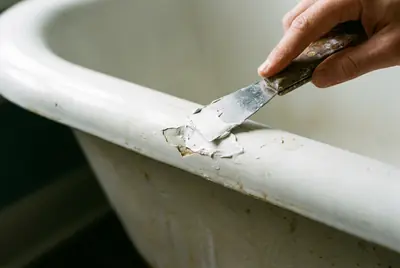
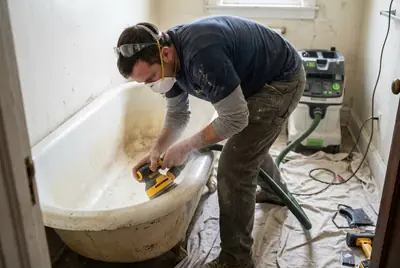
A reglaze fails or lasts on what happens before the gun comes out. The old surface gets scrubbed of soap film and silicone, etched or primed so the new material has something to grip, then wet sanded until it feels like fine paper. Skip any of that and the prettiest coat in the world lets go within a year, which is exactly the story most peeling tubs tell us.

Damage is filled, not painted over

Stage 2 of 3

Damage is filled, not painted over

Chips, rust blooms and worn drain rings are ground back to sound material and rebuilt with polyester filler, then sanded flush until a fingertip cannot find the spot. Coating over damage only photographs well on day one; a repair you cannot feel is what keeps the finish honest for years.

A controlled spray, not a brush

Stage 3 of 3

A controlled spray, not a brush

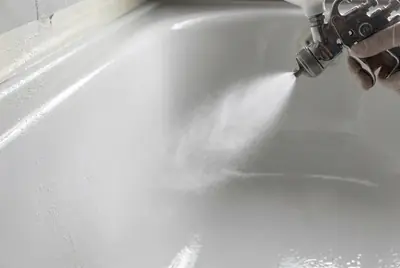
The topcoat goes on in fine sprayed passes with an extractor pulling air out the window the whole time. Sprayed layers flow together into one even skin, which is why the result reads as gloss rather than as paint. Brushes and rollers leave the texture that gives cheap refinishing its reputation.

Reglaze, liner or new tub

Three real ways out of a worn tub. We only do the first one, so the other two columns are simply what we would tell a friend.

The questionReglazing in placeAcrylic linerFull replacement
What a standard tub costs$350 to $800$1,600 to $4,000$3,000 to $10,000 once walls and plumbing join in
Bathroom out of actionOne day, then the cureWeeks of lead time, then a fitting dayOne to two weeks of trades
Demolition involvedNone at allNone, but the old tub is sealed insideWalls opened, floor patched, debris hauled
Honest life expectancyFive years and up when cared forLong, unless water creeps between the shellsDecades
Watch out forPrep shortcuts by cut-rate crewsA spongy feel and hidden moistureThe budget doubling mid-project

If your tub is cracked through, actively leaking underneath, or you simply want a different fixture, reglazing is the wrong tool, a verdict you will hear on the very first callback.

Six passes over one bathtub

Deep clean and etch

Pass 1

Deep clean and etch

Soap scum, silicone and old wax stripped, then the surface etched or bonded so the coating can bite.

Chip and rust repair

Pass 2

Chip and rust repair

Every ding ground out, filled and sanded flush. The repairs disappear under the coating instead of through it.

Masking the room

Pass 3

Masking the room

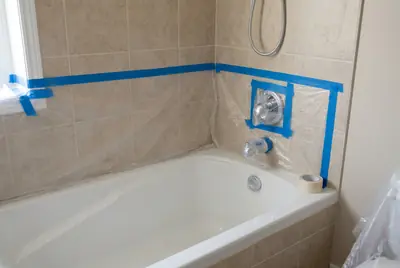
Tile, faucet, floor and glass papered off. Overspray lands on masking paper, never on grout or chrome.

Sprayed finish coats

Pass 4

Sprayed finish coats

Primer, then gloss coats laid on in thin passes until the surface reads as one poured skin.

The cure window

Pass 5

The cure window

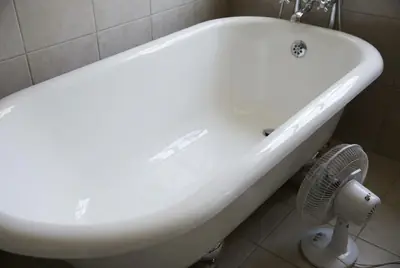
The finish hardens on its own clock, 24 to 48 hours. We tape the door and leave the tub in peace.

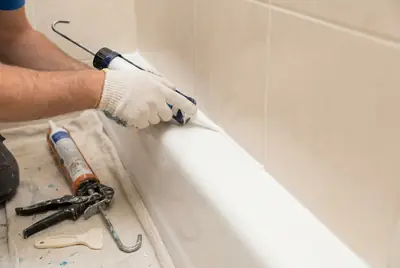
Fresh caulk lines

Pass 6

Fresh caulk lines

Old caulk goes out with the old finish. A new mildew-resistant bead seals tub to tile on the way out.

Refinished, not reborn

A reglazed tub is your old tub wearing a professional coating. That is a fine thing to be, as long as everyone knows it going in.

What the new surface is

A sprayed acrylic urethane skin, bonded to prepared porcelain, steel or fiberglass. It is smooth, glossy, warm to the touch and fully waterproof. Done properly it gives five years and more of daily service, and plenty of our tubs sail well past that with nothing but gentle cleaning.

What it is not

It is not factory enamel fired onto iron at kiln temperatures, and no honest refinisher will tell you otherwise. It can be scratched by grit, dulled by harsh powders and lifted by standing water in a spot where caulk has failed. It is a durable coating, not a new tub, and it is priced like one.

The habits that stretch it

  • Clean with liquid bathroom cleaner and a soft cloth; abrasive powders and scouring pads are the finish's only real predators.
  • Skip suction-cup mats, or at least lift them out after the bath. Trapped water works on any coating given enough weeks.
  • Fix a dripping faucet early. A steady drip wears a track in the gloss the way it would wear a stone.
  • Rinse and wipe after bath oils and hair dye; both stain slowly when left to sit.
  • Tell us about the first chip, not the fifteenth. Spot repairs on our own finish are quick and cheap.

The whole job, measured in your time

Two minutes

You ask for the figure

ZIP, what the tub is made of, what bothers you about it. A short request starts it, and a photo can follow later if the case is odd.

The callback

The figure, in writing

The technician who would do the work asks his questions on the callback and names a firm figure for a standard job, confirmed in writing before any van is booked.

You set the date

The morning of

One van, one technician, drop cloths from the front door to the bathroom. Water off for nothing; only the tub is out of service.

Most of that day

Repair, mask, spray

Damage filled and sanded, the room masked, extractor running, then the primer and gloss coats go on in thin, even passes.

24 to 48 hours

Cure and caulk

The finish hardens untouched, the new caulk bead goes in, and you run the first bath knowing exactly what was done and what to expect of it.

What the work runs

What we quoteTypical rangeReading the number
Standard bathtub, reglazed complete$350 - $800Clean, etch, repairs, sprayed gloss and fresh caulk.
Chip or rust repair alone$150 - $300When the finish is sound and only one wound needs closing.
Clawfoot tub, inside and out$700 - $1,300Two surfaces, more masking, and paint-grade feet if you wish.
Shower pan or base$300 - $550Same process on the floor you stand on every morning.
Caulk renewal with the job$90 - $180Old bead cut out, mildew-resistant line laid in.
Small job minimumaround $250The van, the materials and the cure time exist even for tiny work.

Heavy previous coatings that must be stripped, unusual colors and badly pitted iron push a job toward the top of its bracket. The written price reaches you before the van is even loaded, and it holds.

How we stand behind a coating

Ventilation is not a courtesy, it is part of the job. The extractor runs from the first solvent wipe to the last sprayed pass, pulling air out the window instead of through your hallway, and the technician wears supplied air even when the household has gone out for the day. By the evening the bathroom smells like a bathroom again.

The materials are the professional two-part systems made for this trade, mixed fresh on site, never the single-can kits sold next to the paint rollers. It is the difference between a finish that cures into a hard skin and one that stays soft enough to peel at the drain within a season, and it is most of the reason our work carries a written workmanship promise against peeling and loss of adhesion.

And the schedule respects the cure. We tell you in writing when the tub goes back into service, 24 hours for most jobs and 48 for the cautious ones, because handing a family a beautiful surface and letting them ruin it that same night helps nobody. If anything in our workmanship lets go early, the technician comes back and makes it right without a discussion about whose fault the water was.

Asked while we tape the paperwork

  1. How bad is the smell, honestly?

    Strong while spraying, gone surprisingly fast. The extractor vents the room to the outside for the whole job, so the rest of the home stays livable, and by the next morning the odor has left with the fumes. Pregnant households and bird owners get the frank version of this talk before booking.

  2. When can we actually use the tub?

    Between 24 and 48 hours after the final coat, and the exact time is written on the paperwork you keep. The first bath is not a gamble; it is a date.

  3. Can the color change, or only refresh?

    Any color. The most common request is retiring an avocado, pink or almond tub to white, and the coating is tinted before it is sprayed, so the new color is in the material rather than painted over it.

  4. Do fiberglass and acrylic tubs qualify?

    Yes. The prep changes, the primer changes, the result reads the same. Fiberglass with soft, flexing spots gets extra reinforcement talk first, because coating a moving floor is how warranties die.

  5. The tub was coated before and peeled. Now what?

    Now the old coating comes fully off, which is honest work we price plainly, and then the job proceeds as if the tub had never been touched. Peeling almost always means the first crew skipped the etch or sprayed over silicone, not that your tub rejects coatings.

  6. Is five years all I should hope for?

    Five years is the floor we are comfortable promising out loud, not the ceiling. With soft cleaners, no standing mats and caulk kept sound, these finishes routinely serve a decade. What we refuse to do is whisper twenty and hope you lose our number.

The streets around Bath County

Zoom for the lay of the land; the link lists further down name every community the van reaches from here.

Somewhere under that worn surface is the tub you chose. One day brings it back.

Get my written figure